
ABOUT GANDAHARA AGRICULTURAL AND EDUCATIONAL ORGANIZATION
WHO WE ARE
Our Objectives
Our objectives are to increase access to primary and maternal healthcare for vulnerable and underserved populations through community health outreach and mobile clinics, and to enhance inclusive, quality education for children and youth by supporting community based schools and classes with learning materials and teachers. We also aim to improve household income and food security by providing vocational training, small business support, and access to microfinance for the most vulnerable, especially women and youth. We strengthen community based protection by providing psychosocial support, legal aid, safe spaces, rights based awareness, and stronger reporting and referral services for individuals at risk, including women, children, people with disabilities, and minorities. We ensure safe drinking water and improved sanitation by constructing or rehabilitating clean water points and latrines and delivering hygiene awareness campaigns.OUR CORE VALUES
ORGANIZATIONAL STRUCTURE
ORGANIZATIONAL STRUCTURE
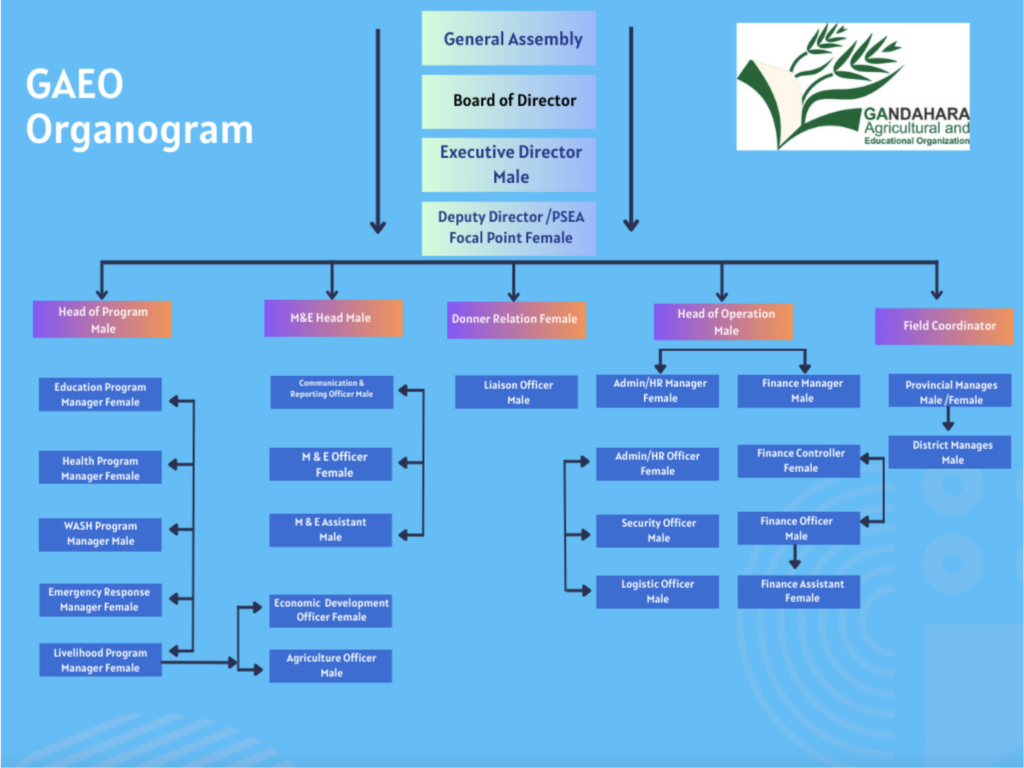
The general guidelines for the governance are spelled out in the constitution (Asas Nama) of the NGO. Anyhow, GAEO consists of board of directors (BoDs), general Assembly, Director of the organization, developmental and technical advisor, executive committee, management committee, supporting staff, project staffs and volunteers.
Developmental and Technical Advisors are selected for proven experience in education, agriculture and agribusiness, human rights, gender, humanitarian relief, and management. They provide practical analysis, strategic guidance, and clear technical standards, helping protect people, rights, and the environment while strengthening program quality, accountability, and results consistently.
- General Assembly
- Steering Committee
- Executive Director
- Deputy Director
- Head of Program
- Head of Operation
- Head of M&E
- Donor Relation Sr. Officer
- Regional Managers
Accountability and transparency
Dedication to accountability and high-level transparency is vital to GAEO work, at an operational and management level. First and foremost, our organization is accountable to the communities with whom it works. Good communication is key to achieving best transparency and we encourage open and honest dialogue, and listen carefully to people’s needs, ideas and feedback. Donor accountability is similarly important and we work hard to maintain and develop appropriate and effective reporting mechanisms. In addition to producing individual reports as necessary, each year we publish our annual report, providing a comprehensive account of our activities, finances, reflections and future goals. We continually achieve excellent results, monitored internally and externally by professional auditing bodies.
GAEO is committed to strengthening its accountability and transparency in interaction and coordination with all stakeholders. Stakeholders of GAEO include: individuals and communities it works with and it’s individuals members, supporters, activists, partners, staffs, volunteers and the general public. Our accountability information already publicly reported includes GAEO reports of the previous projects, approval, periodical meetings with the communities involved and improved by our activities.
The GAEO properly maintains documents pertaining to financial transactions (balance sheets, income & expenditure statements etc.) in an easily retrievable form. Salaries and petty cash registers, fixed assets register etc. are regularly maintained. The audit is the review mechanism that provides assurance to senior management on the effectiveness of internal controls as well as coordinating the finance management process within the organization. It is done every year by professionally qualified accountants. The names of banks and auditors of the organization are circulated to the board members. An annual audit is conducted regularly and the audit report is duly circulated to the board members.