• ABOUT GANDAHARA AGRICULTURAL AND EDUCATIONAL ORGANIZATION

OUR VISION
A peaceful and prosperous Afghanistan through continuous improvement of agricultural resources, economic development, and access to education in every corner of the country.
OUR MISSION
GAEO aims to reduce poverty and provide sustainable livelihoods for people regardless of race, gender, or religious belief by modernizing and developing the agriculture and education sectors.
OUR GOAL
GAEO strengthens vulnerable communities by ensuring fair access to health, education, livelihoods, protection and safe water and sanitation while promoting dignity, inclusion and empowerment.

WHO WE ARE

Gandahara Agricultural and Educational Organization (GAEO) is a national non profit organization registered with Afghanistan’s Ministry of Economy in June 2011. GAEO is headquartered in Nangarhar with a coordination office in Kabul. Guided by an experienced Board of Directors with expertise in good governance, stabilization, and rural and urban development, GAEO delivers community driven programs that respond to the needs of vulnerable people. GAEO’s strength is its professional team and field based approach. We invest in regular technical backstopping, staff training, and capacity building to ensure quality implementation. Our experience shows that strong results come through transparent, inclusive, and participatory work. For each activity, GAEO prioritizes recruiting experienced staff, especially qualified people from the targeted locations who understand local culture and traditions. We also promote gender balance and engage female staff wherever applicable to ensure safe and inclusive service delivery.

Our Objectives

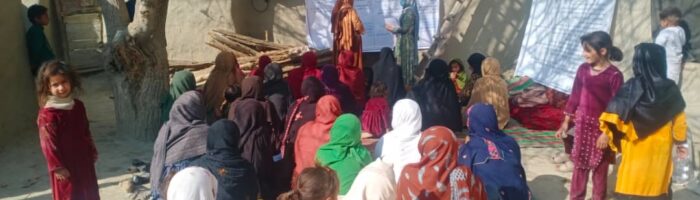
Our objectives are to increase access to primary and maternal healthcare for vulnerable and underserved populations through community health outreach and mobile clinics, and to enhance inclusive, quality education for children and youth by supporting community based schools and classes with learning materials and teachers. We also aim to improve household income and food security by providing vocational training, small business support, and access to microfinance for the most vulnerable, especially women and youth. We strengthen community based protection by providing psychosocial support, legal aid, safe spaces, rights based awareness, and stronger reporting and referral services for individuals at risk, including women, children, people with disabilities, and minorities. We ensure safe drinking water and improved sanitation by constructing or rehabilitating clean water points and latrines and delivering hygiene awareness campaigns.

GAEO provides community based services in agriculture, education, health, WASH, livelihoods, protection, and emergency response, delivering practical support that improves resilience, dignity, and long term well being for vulnerable people.
OUR SERVICES

OUR CORE VALUES

Our core values are integrity through honesty, accountability, and transparency while upholding Afghan NGO laws and the Afghan NGO Code of Conduct. We practice inclusiveness by serving people without discrimination and promoting dignity and equal opportunity regardless of race, gender, age, creed, color, political affiliation, nationality, or belief. We maintain professionalism by not compromising on technical quality and valuing knowledgeable input in implementation. We believe in teamwork through mutual support and collaboration to achieve shared goals and stronger results. We pursue excellence by striving for the highest standards and participatory decision making. We value innovativeness by seeking creative, effective solutions and continuous improvement. We commit to quality through unity of purpose, strong teamwork, and dedication to positive change for our target groups.

ORGANIZATIONAL STRUCTURE

ORGANIZATIONAL STRUCTURE

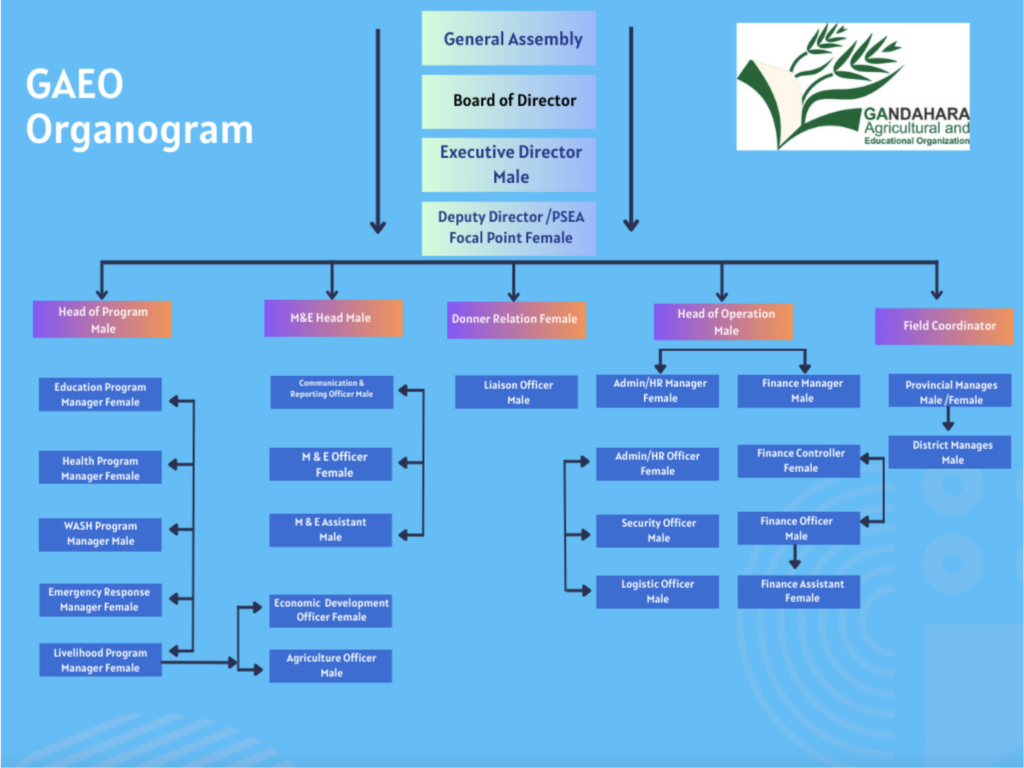
The general guidelines for the governance are spelled out in the constitution (Asas Nama) of the NGO. Anyhow, GAEO consists of board of directors (BoDs), general Assembly, Director of the organization, developmental and technical advisor, executive committee, management committee, supporting staff, project staffs and volunteers.

BOARD OF DIRECTORS
GAEO is governed under Afghanistan’s NGO law by a six member Board of Directors elected by the General Assembly every four years. The Board sets policy, approves programs, safeguards compliance, and holds final authority over key organizational decisions and oversight overall matters.
GENERAL ASSEMBLY
The General Assembly is a twelve member body of qualified professionals representing diverse fields. It elects the Board, approves annual budgets and audited accounts, reviews performance, and builds linkages with donors and financial institutions, acting for the organization when delegated fully responsibly.
EXECUTIVE DIRECTOR
The Executive Director leads day to day management and coordination of all GAEO activities. This role oversees planning, staffing, finance, partnerships, reporting, and compliance, ensuring timely delivery of projects and alignment with the organization’s vision, mission, objectives, and core values always carefully.
DEV/ TECHNICAL ADVISOR

Developmental and Technical Advisors are selected for proven experience in education, agriculture and agribusiness, human rights, gender, humanitarian relief, and management. They provide practical analysis, strategic guidance, and clear technical standards, helping protect people, rights, and the environment while strengthening program quality, accountability, and results consistently.

MANAGEMENT COMMITTEE
The Management Committee translates approved plans into action under the supervision of the Executive Director. It coordinates departments, monitors implementation, resolves operational issues, and reports progress, ensuring instructions agreed with the General Assembly and Board are applied across all projects efficiently together.
MANAGEMENT COMPOSITION
  • General Assembly
  • Steering Committee
  • Executive Director
  • Deputy Director
  • Head of Program
  • Head of Operation
  • Head of M&E
  • Donor Relation Sr. Officer
  • Regional Managers

Accountability and transparency

Dedication to accountability and high-level transparency is vital to GAEO work, at an operational and management level. First and foremost, our organization is accountable to the communities with whom it works. Good communication is key to achieving best transparency and we encourage open and honest dialogue, and listen carefully to people’s needs, ideas and feedback. Donor accountability is similarly important and we work hard to maintain and develop appropriate and effective reporting mechanisms. In addition to producing individual reports as necessary, each year we publish our annual report, providing a comprehensive account of our activities, finances, reflections and future goals.  We continually achieve excellent results, monitored internally and externally by professional auditing bodies.

GAEO is committed to strengthening its accountability and transparency in interaction and coordination with all stakeholders. Stakeholders of GAEO include: individuals and communities it works with and it’s individuals members, supporters, activists, partners, staffs, volunteers and the general public. Our accountability information already publicly reported includes GAEO reports of the previous projects, approval, periodical meetings with the communities involved and improved by our activities.

The GAEO properly maintains documents pertaining to financial transactions (balance sheets, income & expenditure statements etc.) in an easily retrievable form. Salaries and petty cash registers, fixed assets register etc. are regularly maintained. The audit is the review mechanism that provides assurance to senior management on the effectiveness of internal controls as well as coordinating the finance management process within the organization. It is done every year by professionally qualified accountants. The names of banks and auditors of the organization are circulated to the board members. An annual audit is conducted regularly and the audit report is duly circulated to the board members.